Tarred and Feathered, a visual collaboration between Maryam Eisler and Kenny Schachter, 2026
Maryam Eisler speaks with artist, writer, and lecturer Kenny Schachter on text, doubt, and radical honesty within the art world
Follow LUX on Instagram: @luxthemagazine
Maryam Eisler: You’ve spent decades exposing the absurdities of the art world. Has it become more absurd, or are you just better at spotting the performance?
Kenny Schachter: There are always changes in the fabric of the culture, in the machinations of the world. And certainly there have been some significant technological changes over the last ten years. But morality and integrity remain a bell curve.
Human behaviour characterises the art world. The world is small, and the art world is minuscule. Even though things have broadened tremendously through social media, which has really blurred geographical boundaries, the art world still remains a microcosm of the greater social, political and economic landscape. The opportunities are so hard-fought and so limited, and somehow the art world just doesn’t expand. I think a lot of that has to do with the mindset of those who yield the most influence and authority. They keep it a very small universe, where success affirms success, and there’s very little interest in going beyond that universe, sadly.
ME: You’ve been an artist, dealer, critic, curator, collector and teacher. Which of those roles lies the most – and which tells the truth?
KS: The way I would define myself in 2026, sitting on a park bench with you beside a highway in the Hamptons is: I’m an artist, a writer and a professor, a teacher. I’ve been fifteen years at the University of Zurich, where I serve on the advisory board, and I lecture at the School of Visual Arts, NYU, Yale, Columbia and various other places.
Joseph Beuys said that his greatest legacy in his art career was his teaching, because you’re instilling something, giving something concrete to your students that they can utilise in their lives. But honestly, I also love to write so much because, for me, there’s a very visual, aesthetic quality to putting text down. It has a sculptural, physical presence. I love the way it originates through an ideational concept, then it’s reduced to fragments, then it becomes an outline, and then it takes the form of paragraphs. For me, it has a sculptural effect.
Read more: Miles Aldrige’s 15 Minutes of Fame Polaroid Project
The fact is, I don’t differentiate between teaching, writing and making art. That’s what I do. Even when I’ve had these crazy auction sales out of economic necessity to make a living, I’ve turned them into something else. I sat at Sotheby’s and filmed a documentary, and most recently I did a sale at Phillips and sat there the whole week and made a performance out of it.
People in the art world always silo you. They’re always compartmentalising, always pigeonholing you. Life is not so simple. Blurry boundaries, for me, are tremendously interesting. I don’t differentiate between any facet of what I do. It’s all one and the same. It’s under the rubric of art, and art imbues my life with meaning. Besides my kids, it’s all I care about.
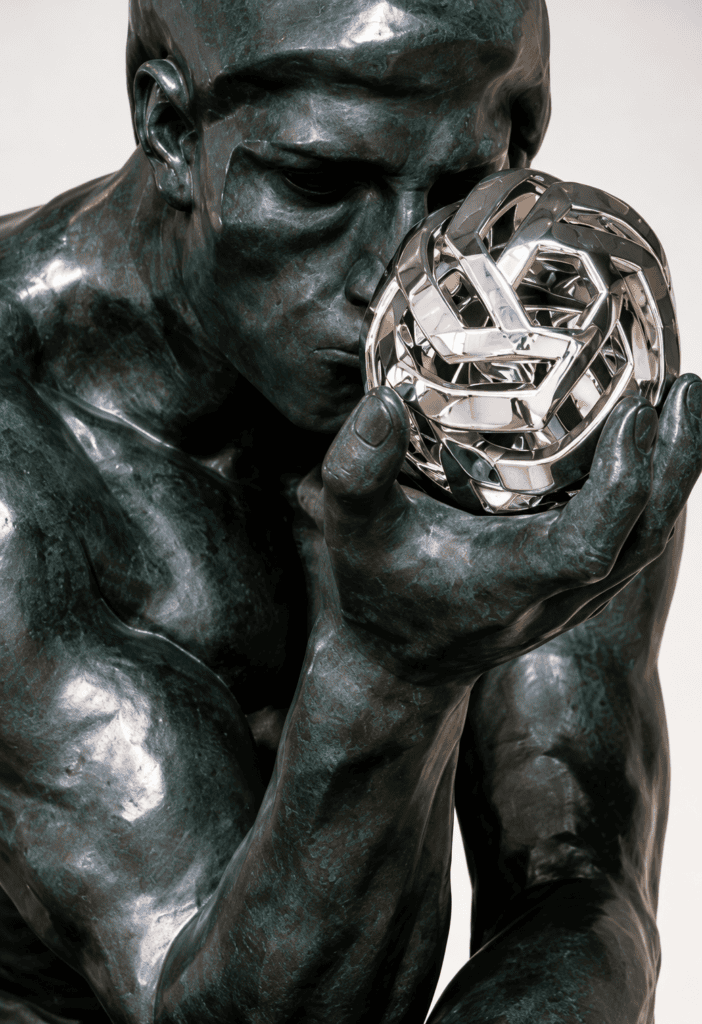
Cognitive Outsourcing (GPT Variant) in patinated bronze, 2026
ME: If you could create an exhibition anonymously, who would be in it? And who definitely wouldn’t be in it?
KS: That’s impossible to answer. My art would be in it! If you come and see the way I live, there are some artists who surround themselves with the work of their peers, some artists who only surround themselves with their own work. My life is wallpapered in art. For me, it’s a window into another experience. Every day I rub my nose against a drawing or a painting.
If you come to my house – and whoever reads this is more than welcome to, if they say hello and please – I honestly mean that. We really need that kind of generosity of spirit today. There’s such a lack of humanity, socially and politically.
My studio, where I work, is surrounded by small works: lots of drawings, small objects, small paintings. Every piece tells a story. It’s some form of personal relationship.
I would basically transform my workspace into an exhibition space without putting my name on it. It would tell a story, and the more willing you were to look and to see, the more that story would unfurl. Art is a slow-burning process that takes time. There is no immediate gratification. People want a quick fix. We’ve been programmed through computers and social media to see things in this constant stream of information, but life is not like that.
As for who wouldn’t be in the show, it would be the most obvious names of people who have just kind of stopped. Someone like Damien Hirst was a great artist, a conceptually brilliant artist, but he just stopped and became a cash-grabbing kind of… He lost the faith, and it became all about the materialism of accumulation and greed. I’m just uninterested. If you go to my workspace or my house, you wouldn’t see the obvious things by the obvious people. I’m not trying to make a statement in and of itself. It’s just very personal and important to me.
Read more: Simon de Pury interviews French artist JR
ME: You’re famous for saying the quiet part out loud. Has radical honesty become easier with age, or does it just get more expensive?
KS: It’s certainly not easy. I’ve had personal threats, physical threats, legal threats. And now that I’ve been trying to help artists more over the past year by calling out certain practices by unscrupulous galleries, my degree of fact-checking has become excruciating.
So I would say it’s gotten a bit harder. When I was drinking more and my behaviour was a little more capricious, I gave less forethought to the process. Now I’m very aware and conscious, as are my editors, because we all bear responsibility personally and equally.
The art world is so rife with opinions, yet so few people will ever express them because the art world is so goddamn transactional. Everyone is so cautious. They’re fearful of alienating wherever the next deal might come from. I always find a way to hustle and get by. I think I’m almost compelled to do what I do because no one really does it in that way. It’s probably the dumbest thing anyone could possibly do, but it’s become a trademark by default.
I never set out to be this investigative character in the art world. But everyone has an opinion at a cocktail party or behind somebody else’s back. I just feel someone has to call to task some of the hypocrisy and disingenuousness of the art world. It’s difficult and gut-wrenching. I’ve forewarn it a million times and said I would never do it again. But I can’t help it.

Turducken, painted and cast in aluminium and rhinestones, 2026
ME: Imagine an archaeologist 500 years from now uncovers our art world. What would surprise them most?
KS: They would just be flummoxed. They’d scratch their head in disbelief and wonder how any system as flawed and imperfect – and hermetically closed – as the art world could exist… and say ‘Why?’
Art is not just self-expression; it’s communication. But it does such an awful job of communicating, which is sad and tragic, because art differentiates humans as a species. No other species on the planet makes art.
Last night I was speaking about how I tragically lost one of my kids. If it wasn’t for art and my children… art has imbued my life with meaning. It’s something that transcends politics, religion, economics. There’s something extraordinarily generous about it – a generosity of spirit that I find lifesaving and extraordinarily significant.
Art can’t exist in a vacuum. Even the most extraordinary Frida Kahlo or Giotto in a forest has no significance. It has to be a shared, mutual experience. There’s a social aspect to it. It can’t exist without that human connection. No AI, no computer, could ever substitute for two people sharing a space together, like we’re doing today.
Read more: Joseph Kosuth in conversation with Maryam Eisler
ME: Is there one myth about success in the art world that even smart people still desperately want to believe?
KS: A thousand. People equate success, in every facet of society, with external markers. We live in a very reductive, zero-sum world where one person advances at the direct, measurable expense of somebody else.
In the art world, success is measured by what gallery you’re showing with, what your last auction price was, whether you sold something at an art fair. And it just has nothing to do with it. The art world is a universe where success affirms success. When you make a body of work that succeeds, the expectation is that you’ll continue in that vein and replicate what came before because it succeeded. To me, that is anathema to what art is about: curiosity, restlessness and a constant challenging of conventions – even conventions from within your own artistic output and expression.
For me, it’s all about the idea. I studied philosophy. I never took an art class until I was teaching one. For me, art is a material expression – giving form to ideas. That’s what I love about it.
ME: Speaking of ideas, you continue to oscillate between writing and creating. Do you think your writing informs your art?
KS: Like I said before, there’s a great history of text in art, whether it’s Braque, Picasso, Schwitters, Barbara Kruger, Richard Prince, Ed Ruscha and a million other artists.
Part of the reason my art career developed sprang from the fact that when no galleries would entertain showing my work, I began embedding my artworks into my writing. My art generally springs from imagery that appears whole cloth in my mind’s eye. I don’t differentiate between a picture of a tree or a flower and the verbal or written expression of those things. For me, it’s just one continuum. Again, the art world loves to compartmentalise and file things away in neat little ways. But I just don’t think life is so simple. We live in a world where there’s so much blurring of different aspects and pursuits.
Why do we always need to categorise things that are beyond categorisation?
ME: Late at night in the studio – your home /studio – what kind of doubt still takes you over?
KS: God, it’s not just at night. It’s morning, noon and night. Sometimes I throw my hands up in the air and think: Who am I fooling? Why am I doing this? Is it vanity? Is it futile?
It’s very hard economically. It’s always a struggle and a hustle, which is part of the fun. I don’t like easy, and I fear complacency. But I’m rife with doubt, neurosis, anxiety – all of those things. I’m always smiling on the surface, but not too far beneath the surface I’m harbouring great doubt all the time.
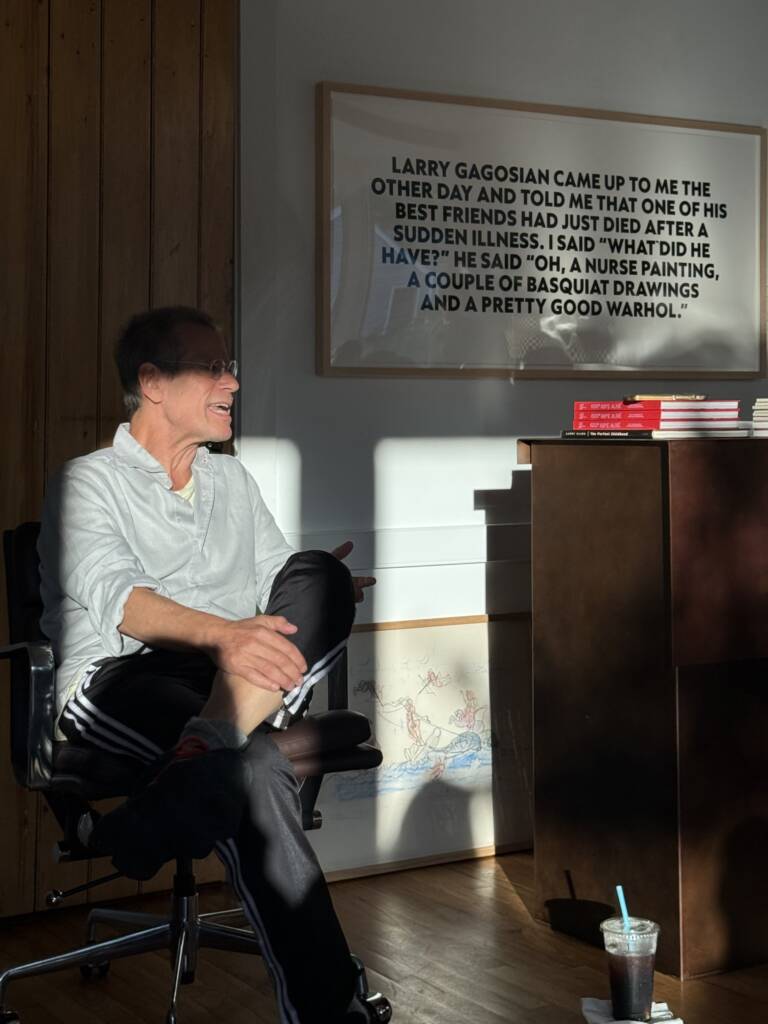
Kenny as captured by Maryam Eisler during a talk at his exhibition Art Apocalypse (Again), 2026
I’m making a sculpture now, vaguely based on Charles Ray, where I’m fighting myself. It’s abstracted – it’s not that self-aggrandising – but it’s like me versus me.
Recently I submitted an article to my editor. When you write, when you make art, when you photograph and you’re behind the camera, you’re by yourself. You’re so isolated. I literally wrote to my editor and said, “Is it okay?” I honestly would not have been taken aback had he replied, “It’s awful. It really needs a lot more work.”
He loved it. But I honestly had no idea whether it was the best thing I’d done or the worst. That’s me versus me. And when I said that to him, it became the basis of a sculpture.
ME: You spend a lifetime creating work, but also a lifetime looking at other people’s work. Is there one work you’re truly jealous of not having created yourself?
KS: I would say Paul Thek. He was an artist who moved between multiple, disparate bodies of work, and he paid an enormous price for it. He lived in Europe for a large part of his career, before there were more accessible means of communication. After a great deal of early success in the ’60s and early ’70s – commercially and institutionally – he lived in Italy, amongst nature and by the seaside. He was out of sight, out of mind.
He fluctuated wildly between disparate bodies of work, and towards the end of his life he was working in a supermarket, for Christ’s sake. He was destitute. I remember being frozen in my tracks by seeing one of his pieces: a shard of encapsulated flesh in a vitrine. The work operated on so many levels. It was a critique of Minimalism, of the austere, fabricated, cold and sterile nature of a Donald Judd sculpture. And it looked literally like a cross-section of human flesh, yet it was handcrafted with wax and various fragments to constitute the visceral nature of flesh.
Read more: Pirelli HangarBicocca in Milan shows Aki Sasamoto and Luciano Fabro
When you’re young, lighting the candle at both ends, it never occurs to you how vulnerable we are – how pronounced and extreme the fragility of life is from one day to the next. There’s a hair that separates repulsion and seduction. I find those meat pieces extraordinarily beautiful. They’re absolute feats of human creativity. They’re harrowing and they instil fear in you, yet they’re so covetable.
Another misconception is that art has to be big. Some of these pieces are six or eight inches – we’ll leave that size reference alone !- but sometimes it’s not the size that matters. It’s the quality and the depth. The depth of the idea.
Paul Thek was absolutely fastidious. And another really important key to any career, which I always tell my students, is that tenacity and perseverance are the keys to success. It’s not having a sale. It’s not being picked up by the right gallery. It’s never giving up. It’s carrying on and being steadfast in the face of rejection – when you get a terrible negative review, when a gallery doesn’t fulfil its obligations, or when you can’t even get a gallery.
The art has to come from this pure place where you just have no choice. The art chooses you.
ME: Last question. If the contemporary art world had to pick one animal as its supreme leader, what would it be?
KS: The art world, as we know it and disdain it? It would be a fucking big pig.
ME: I thought you were going to say a snake.
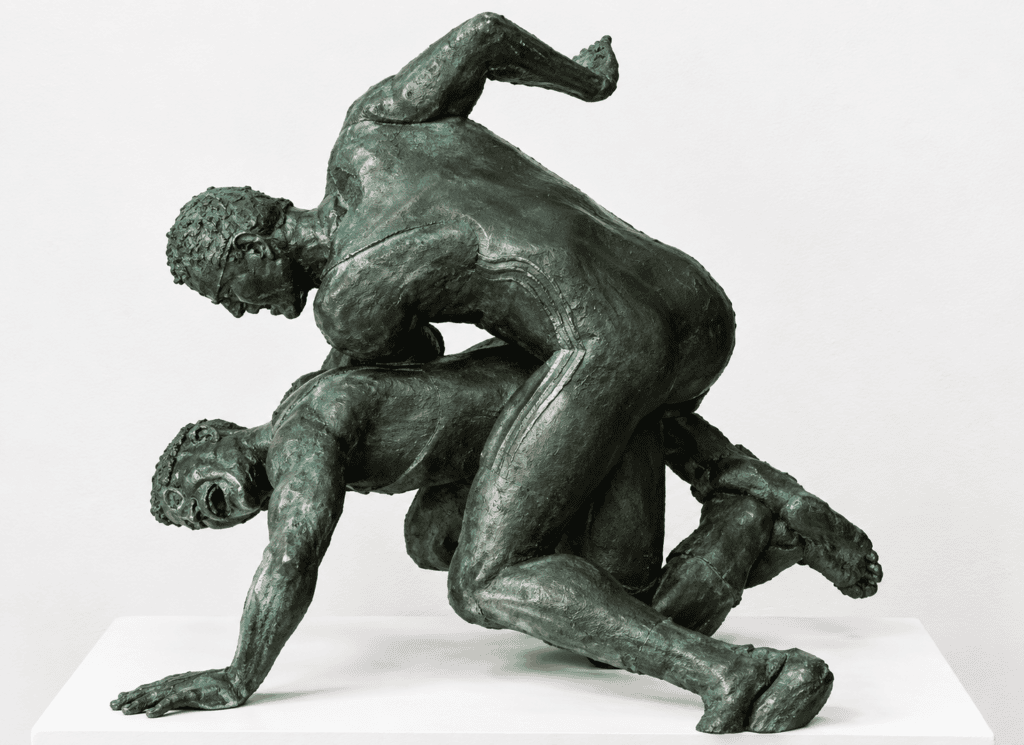
Ourselves Alone, in patinated bronze, 2026
KS: No! Pigs are cute! Honestly, being a writer means every time I get screwed or have a negative experience, it becomes material. Last night I mentioned Elon Musk and someone literally stood up and stormed out of my talk. When I get a terrible negative review – I’m not going to deny that the last one didn’t bring a tear to my eye; it was so mean-spirited and personal – you use it as fodder.
My art dealer in Germany once told me I couldn’t paint, that my paintings were god-awful, and not only should I never pursue painting, I shouldn’t pick up a pencil and draw ever again. So I made an art piece out of it. Everything is material, whether you’re a writer, a comedian or anything else in life. You have to stay true to your intentions, and you can’t let anything or anyone get in the way. That’s the mantra I have to carry on.
I’ve had a friend who stole all of my money at a given time. I had a dealer who wouldn’t pay me for sales that had been consummated and for which he had been paid. But you just have to pick yourself up by the bootstraps and carry on. You have to be emboldened by these roadblocks because nothing good is easy. Anything too good to be true is too good to be true.
I love what I do in the field of art, in all of its guises, probably more today than I ever did in my life. I never would have dreamt that I would have half the opportunities I’ve had, and nothing has been given to me. That makes it all the more enjoyable. And to see my kids start to flourish is even more gratifying than my own opportunities. I love to help my students – and anyone who asks, in a gracious fashion, for help or advice, besides “How can I sell my art?”
After the loss of a child especially, helping other people has become very satisfying.
Kenny Schachter’s upcoming solo exhibition will be taking place at Alex Berns NYC in May 2027.