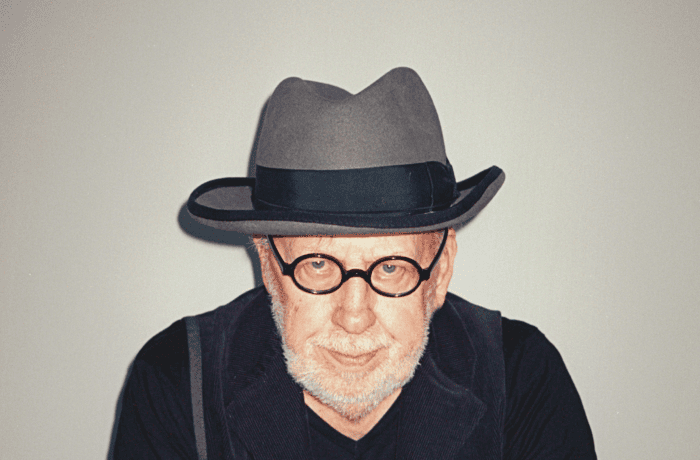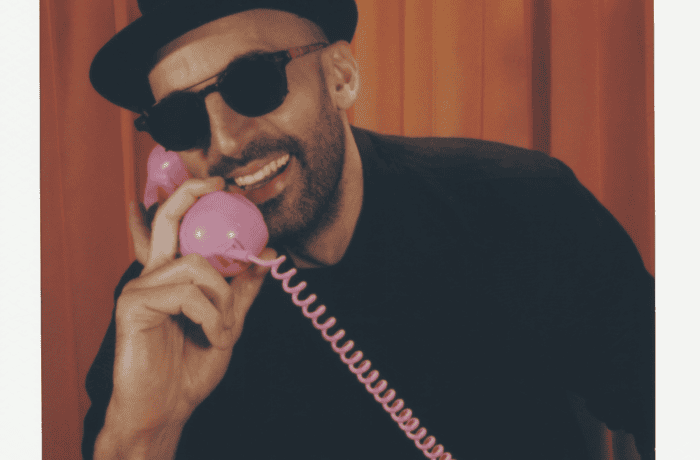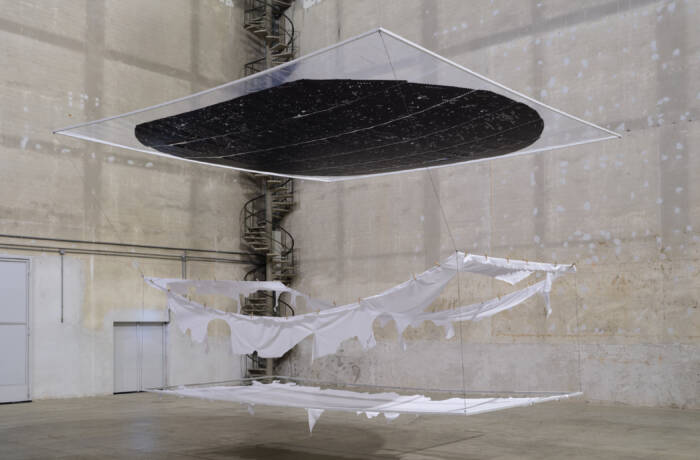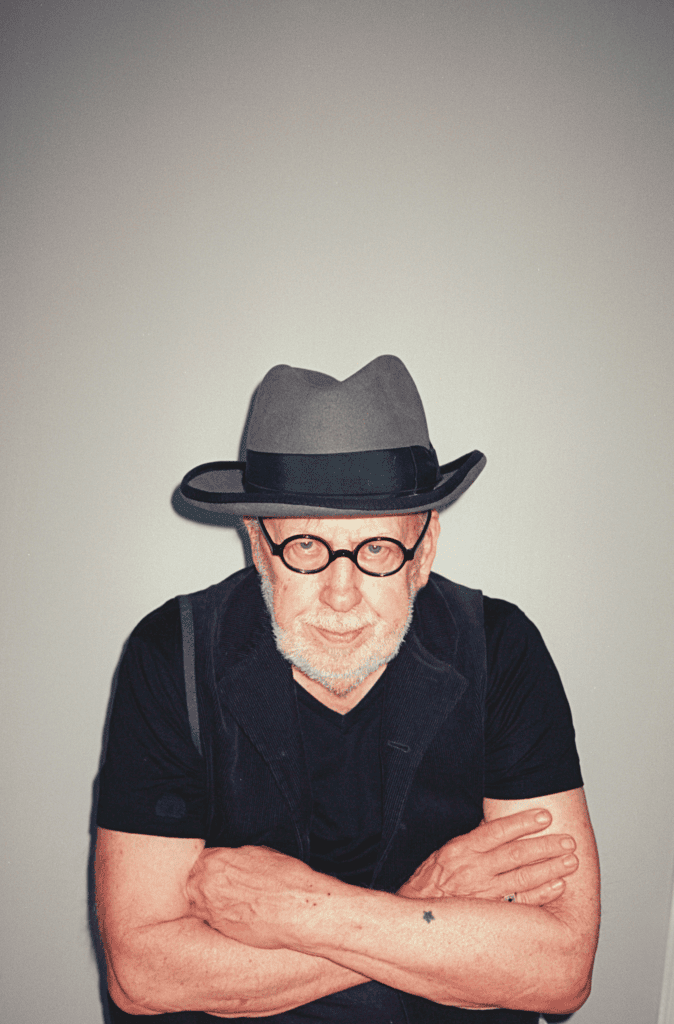
The artist Joseph Kosuth, photographed for LUX by his daughter Klió Kosuth
A pioneer of conceptual art, Joseph Kosuth dazzled the art world in the 1960s with his seminal, era-defining work. Sixty years on, in the age of AI, the questions Kosuth asks about art, meaning and language – across a body of work that includes text, neon and installation – seem more relevant than ever. In a rare interview, coinciding with his new Venice exhibition, the artist speaks with photographer and LUX Chief Contributing Editor Maryam Eisler
Follow LUX on Instagram: @luxthemagazine
Maryam Eisler: Your 1965 work ‘One and Three Chairs’, which combines a chair, a photograph of a chair and a photograph of a dictionary definition of a chair, is one of the defining works of conceptual art. Looking back, do you think the work has been misunderstood, and what is the deeper question you hope it would continue to provoke?
Joseph Kosuth: The work asks how meaning is produced and what conditions allow something to function as art. The chair simply provided a neutral vehicle. If the work continues to provoke anything, I hope it encourages viewers to question the assumptions they bring to language, images, objects and, ultimately, to art itself. The artwork exists in that inquiry rather than in any particular material form.
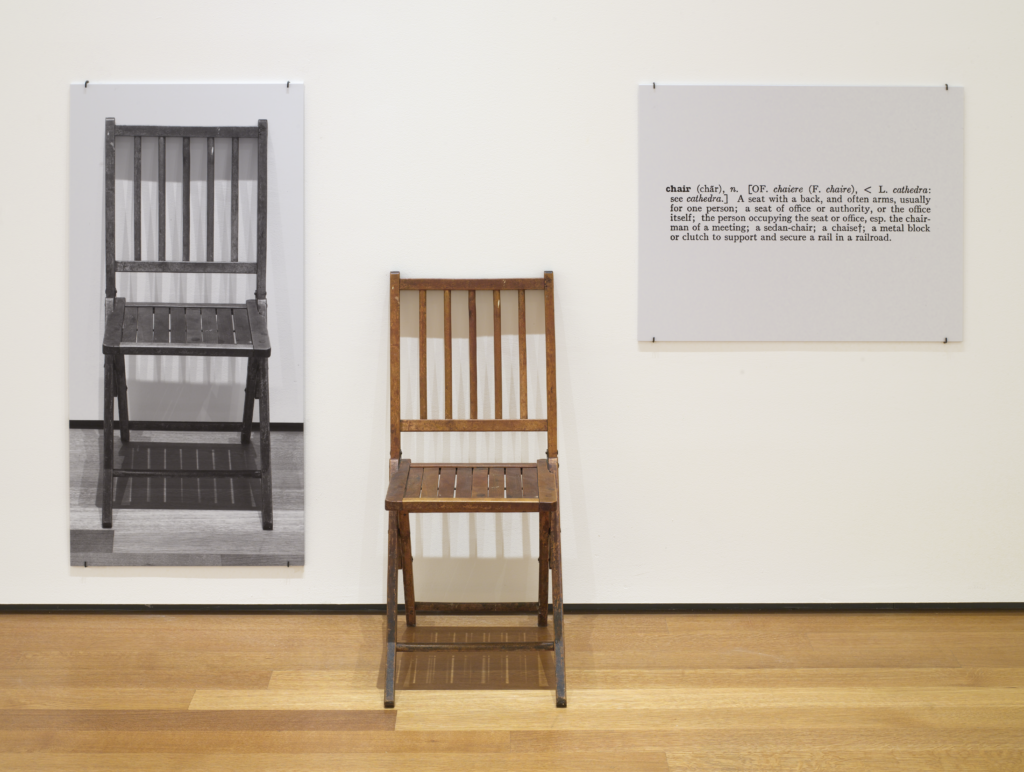
Kosuth’s defining conceptual artwork, ‘One and Three Chairs‘, 1965, at the MOMA collection, New York
ME: In your 1969 essay Art After Philosophy, you argued that, after Duchamp, art’s task was to investigate the nature of art itself. More than 50 years later, has contemporary art remained faithful to that proposition or shifted elsewhere?
JK: When I wrote Art After Philosophy, I was describing a historical condition rather than prescribing a permanent programme. Duchamp made it impossible for artists to ignore the question of what art is. Whether contemporary art has remained faithful to that insight is another matter. Much of today’s art has become entangled with spectacle, markets and identity as forms of consumption. Yet there are still artists who understand that art’s critical capacity lies in examining its own conditions of meaning. That question has never disappeared; it simply competes with many others.
Read more: Rachel Verghis in conversation with Rolf Sachs
ME: Throughout your career, you have entered into a dialogue with thinkers such as Wittgenstein, Nietzsche, Freud and Derrida. When you select a particular text, what are you seeking? Extension, challenge or a different framework entirely?
JK: None of those, exactly. I have never approached philosophy as a source of ideas to illustrate or as an authority to validate what I do. Philosophy has functioned for me as a working context, a way of clarifying the conditions under which art can be understood. Wittgenstein, Nietzsche, Freud, Derrida and others are not influences in the conventional sense. Each of them reveals moments when the assumptions embedded in language, meaning and culture become visible.
When I work with a text, I am interested in what it makes possible rather than what it says. A philosophical text is itself a cultural object whose meaning changes according to the context in which it is encountered. By placing it within the context of art, the text is not simply quoted. Itsfunction is transformed. It becomes part of an inquiry into how meaning is produced. Art, for me, has never been about expressing philosophical ideas. It is another form of thinking, one that can examine the structures through which meaning, including philosophical meaning, comes into being.

A Chain of Resemblance, 2025, one of Kosuth’s more recent neon pieces, on show at Casa deli Tre Oci, Venice, 2026
ME: Your site-specific installations show that meaning is inseparable from context. How much of a work exists before it enters a space and how much is created through its encounter with that site?
JK: A work is never complete before it enters its site because context is not a backdrop; it is one of the work’s materials. Meaning emerges through the relationship between language, architecture, history and the viewer’s experience. My role is to establish the conditions for that encounter. The site is not where the work is installed, it is where the work comes into being.
ME: Whether in ‘One and Three Chairs’ or in your dictionary works or neon pieces, language is never just descriptive, it becomes the work. At a time when AI generates language, interpretation and even philosophy, does that change your relationship to language itself?
JK: It confirms something rather than changing it. Language has never been valuable because it expresses an authentic inner self. It has always been a cultural system whose meanings are produced through use. AI demonstrates how language can be recombined algorithmically, but that tells us very little about thought. Art does not depend upon the production of sentences; it depends upon the production of critical contexts in which language becomes newly significant.

“When I work with a text, I am interested in what it makes possible rather than what it says” – Joseph Kosuth
ME: Has the institutional embrace of conceptual art preserved its intellectual force or inevitably neutralised some of its edge?
JK: Institutions inevitably historicise what once challenged them. That is their function. Every avant-garde eventually becomes part of the narrative it sought to disrupt. But institutional acceptance does not invalidate the questions. It simply means that artists must discover new ways of asking them. Criticality is never guaranteed by a style; it depends upon how a work positions itself within its historical moment.
Read more: Pirelli HangarBicocca in Milan shows Aki Sasamoto and Luciano Fabro
ME: Your work asks viewers to think before they feel, yet many describe a delayed but distinct emotional response. Do you see reason and emotion as opposing forces or ultimately converging?
JK: I’ve never accepted the distinction between thinking and feeling as absolute. Thought has emotional consequences, and emotion is structured by thought. What some people describe as a delayed emotional response may simply reflect the experience of recognising that one’s assumptions have shifted. That moment can be deeply affecting. Conceptual art doesn’t reject emotion; it arrives there by another route.
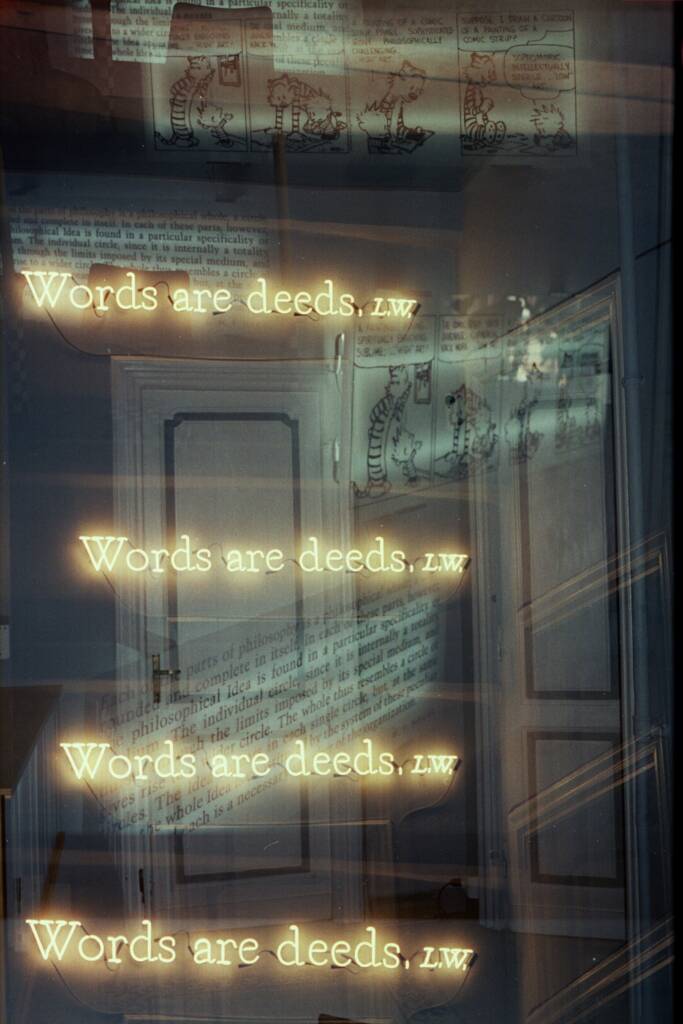
Kosuth’s work has often drawn on the linguistic and philosophical ideas of Ludwig Wittgenstein, as referenced in the neon piece, above
ME: Have there been moments when translation or even mis-translation within different cultural contexts revealed meanings that you hadn’t thought of and even altered your understanding of the piece?
JK: Absolutely. Translation often exposes aspects of language that remain invisible within one’s own linguistic habits. Sometimes a mistranslation reveals possibilities more interesting than fidelity. Since my work frequently depends upon language’s ambiguities, each cultural context becomes another interpretation rather than a distortion. Those encounters have certainly enriched my understanding of the work.
ME: Looking back over your career, has your work changed more through evolving ideas or through shifting political, cultural, institutional context?
JK: Ideas have remained remarkably consistent throughout my career. What has changed are the contexts in which those ideas operate. Political, institutional and cultural conditions inevitably alter how work is read. The artwork doesn’t remain static, because meaning is historical. Every generation asks different questions, and consequently discovers different answers.

One and Eight – A Description, 1965, exhibition view at Casa dei Tre Oci, Venice, 2026
ME: Your entire practice questions what constitutes an artwork. Do you think your own definition of art has shifted since you first articulated it?
JK: Definitions are always provisional because art continually redefines the conditions under which it operates. I remain convinced that art is distinguished less by appearance than by function – by the questions it asks of itself. The vocabulary has evolved, but the underlying proposition has not altered very much.
Read more: Arch Hades in conversation with Catherine Loewe
ME: Is there one work of yours that still surprises you, whose meaning keeps shifting beyond your original conception?
JK: Probably ‘One and Three Chairs’, though not because the work itself has changed. Rather, the conversations surrounding it continue to evolve. Every generation approaches it with different assumptions, and those assumptions reveal as much about the present as about the work. That ongoing reinterpretation is perhaps the most interesting aspect of any conceptual piece.
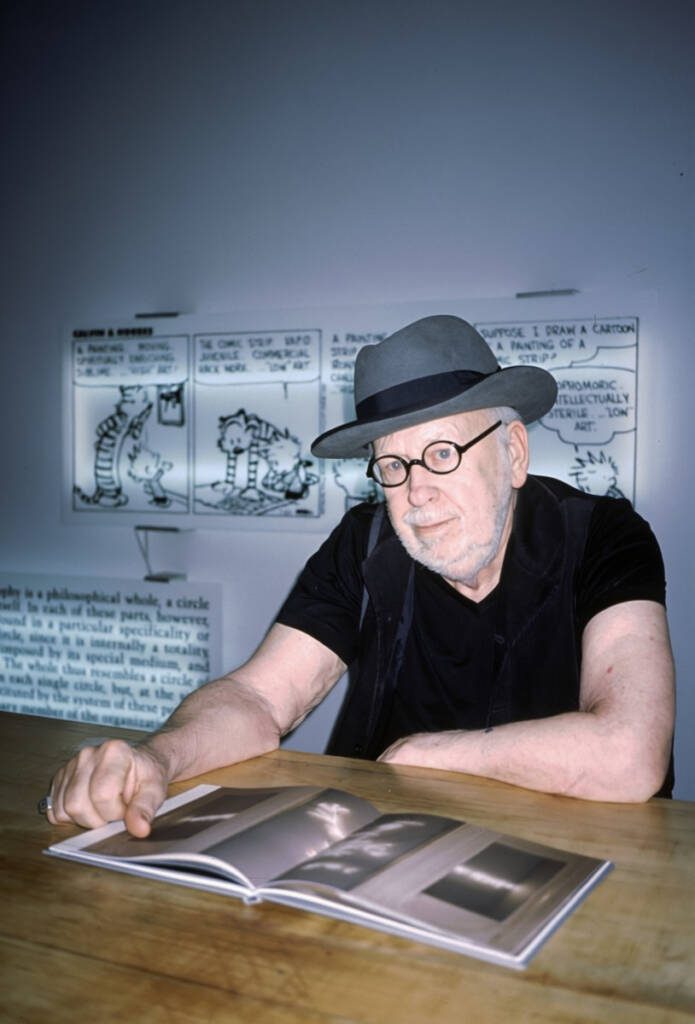
Joseph Kosuth at his studio in Rome, photographed by Klió Kosuth, 2026
ME: Rather than closing on legacy, I’d rather look forward. What’s on your mind right now? What questions or directions feel genuinely unexplored to Joseph Kosuth today?
JK: The only meaningful question is whether there remain assumptions that have yet to be challenged. Every historical moment naturalises its own forms of knowledge, and art still has the capacity to expose that process. As long as language, culture and institutions continue to evolve, there will be new conceptual territory to investigate. The work is never to arrive at certainty but to keep the questions alive.
“The-exchange-value-of-language-has-fallen-to-zero”, an exhibition by Joseph Kosuth, at Casa deli Tre Oci,Venice.
Photography by Klió Kosuth