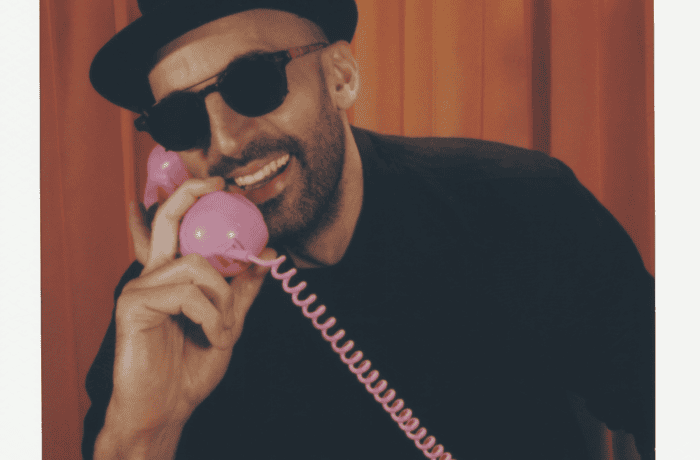
Miles Aldridge captures LUX cover star JR, as part of his ongoing series, the 15 Minutes of Fame Polaroid Project.
JR is the French contemporary art phenomenon who wrapped the Pont Neuf in Paris, and is fêted by next gens and established generations alike. Photographed on Polaroid for LUX by Miles Aldridge, and illustrated by Jonathan Newhouse, he is interviewed by Simon de Pury
Follow LUX on Instagram: @luxthemagazine
Simon de Pury: JR, you are the only artist who became a mega celebrity by using just two letters. Wikipedia indicates this stands for the initials of your first name Jean-René, but your full name remains a mystery. When did you start using a pseudonym?
JR: I started using my initials when I was maybe 13 years old, carving them on the desks at school. So the JR came very early on. Then I started out in graffiti and it quickly became my signature. So it’s true, I’ve had this signature since I was very young and it has never left me. From the beginning of the internet, I created my website, which is still the same. Naively, I didn’t realise JR was a common pseudonym in the United States, though I believe that when you search it online now, the JR from Dallas has disappeared in favour of a more artistic JR. So maybe that’s good news.
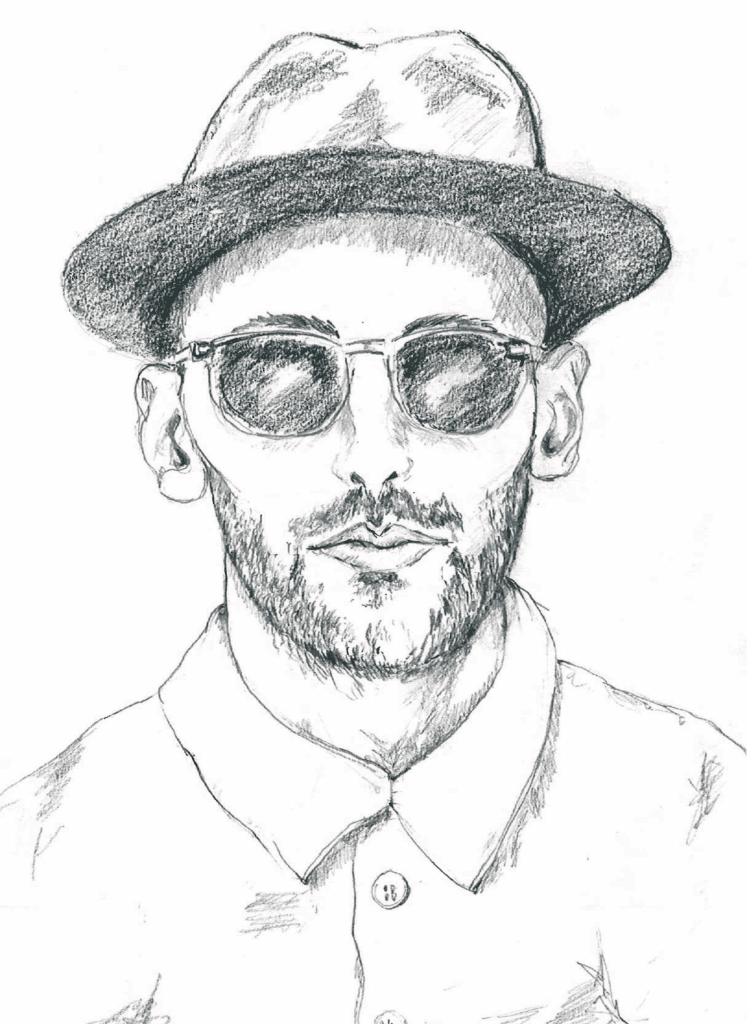
A pencil portrait of JR for LUX by Jonathan Newhouse.
SdP: The eyes of the many children you have photographed and pasted on buildings have contributed to you becoming known. Yet I have never seen you without sunglasses. Is this a conscious decision to set up a further distance than already exists between a photographer and his subject by the camera itself?
JR: Actually, at the very beginning, I did show my eyes. But my first projects were done without permits, so I had fines and complaints, notably one from the mayor of Clichy-Montfermeil when I was 18. In many countries, I got arrested, detained or deported. It forced me to find a way not to get spotted. When I take off my hat and sunglasses I become anonymous, and when I put them on, that’s how I’m recognised. In many countries where art is not received in the same way as in France or the US, or in much more open countries, it allows me to travel freely and to still be able to create. So the hat and the sunglasses came about, not as a way to create a total anonymity, but maybe a semi-anonymity. The sunglasses aren’t something I necessarily keep on when I photograph people; the people I photograph see my eyes. It’s more on the internet, and when people take pictures of me, that I wear the hat and sunglasses. Otherwise, people who meet me see my eyes. It’s a semi-anonymity that works very well for me.

Il Gesto, JR’s response to Veronese’s The Wedding at Cana, is on view at Palazzo Ca’da Mosto, Venice.
SdP: As with Jean-Michel Basquiat or Keith Haring earlier, the art world and art market embraced you once you had already obtained credibility in the street. What were your first steps in the “established” art world?
JR: My first steps in the art world were by chance, because I didn’t know an art world existed. The first time I went to a more legitimate gallery was in London, where Banksy and his agent, Steve Lazarides, invited me to exhibit. That was the first time my works were exhibited in an official way and that I had a solo show. Surprisingly enough, the first person who came to buy was Damien Hirst, who bought quite a few works of mine. But I was very young and I was discovering this world, I didn’t know all the artists and so on yet. I didn’t realise yet that we were players in it ourselves.

“When I take off my hat and sunglasses I become anonymous, and when I put them on, that’s how I’m recognised” – JR. Photographed by Miles Aldridge.
SdP: Emmanuel Perrotin, one of the world’s leading contemporary-art dealers, who has played a key role in the careers of Maurizio Cattelan
and Takashi Murakami, represents you. How did this relationship start?
JR: Emmanuel contacted me when I was 27 or 28. I had already been creating and exhibiting for around 10 years, but while he was in China on a highway he saw a little water tower on top of a building, and because he had seen one of my collages, he instantly recognised – without seeing JR written on it – that it was mine. And he thought to himself, “If this artist is so recognisable without even adding his signature, I have to meet him.” He came to see me in New York and that’s how our relationship started. We talked together, brainstormed together, and now we’ve been working together for more than 15 years. We’ve done a lot of exhibitions and projects with him and his teams. It’s a very beautiful collaboration that I am very proud of.

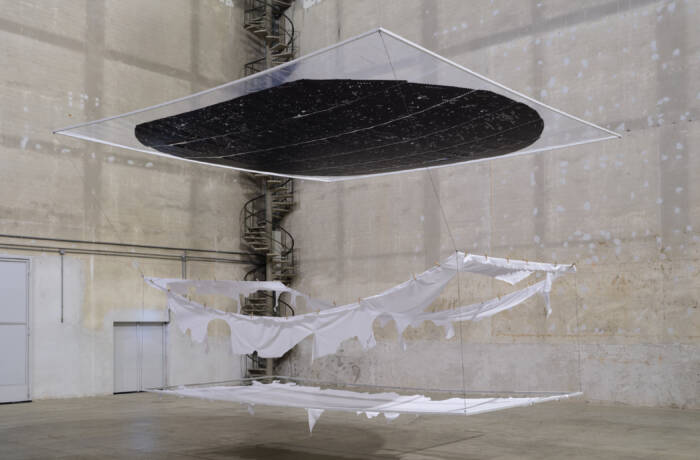
JR’s La Caverne du Pont Neuf, 2026, pays tribute to Christo and Jeanne-Claude’s The Pont Neuf Wrapped, which in 2025 celebrated its 40th anniversary.
SdP: You’re an artist who breaks with tradition. Before, only artists such as Christo and Jeanne-Claude were thinking as “big”. Your transformation of the Pont Neuf in Paris in June, 41 years after theirs, was beautiful.
JR: It’s true, Christo and Jeanne-Claude have been a great inspiration to me, because of their funding model, and for the scale of their projects. Being able to wrap the Pont Neuf 40 years later is an incredible honour for me, and it’s been, so far, one of the most important projects of my career. At the same time, every project is a new challenge, a new path. I don’t necessarily think in terms of grandeur. The Pont Neuf was something I had never thought about, before the invitation from Christo’s nephew Vladimir Yavachev. However, my projects at the Louvre in 2016 and 2019, at the Opéra in 2023, and others abroad, were also gigantic. But I measure a project by people’s involvement and how much it draws people together. That’s at the heart of my work and sets me apart a bit more from Christo and Jeanne-Claude’s work, because I love people’s participation and having people come and help glue and take part. That’s part of my DNA. For La Caverne du Pont Neuf, I was less able to involve as many members of the public, of course, due to the nature of the construction of the “cave”, which took 850 people to create. But when my work brings thousands of people together, for me, that’s very powerful.