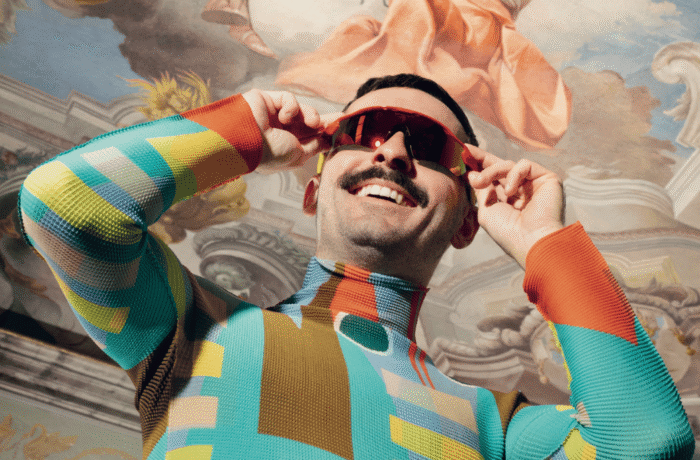
A portrait by Simon de Pury. With thanks to Alia Al-Senussi for the LUX introduction to Kulapat
Kulapat Yantrasast is the “starchitect”of the art world, designing a new department of the Louvre in Paris, the upcoming National Museum in New Delhi, and Dib Bangkok, the recent contemporary art museum in his native Thailand. In a scintillating conversation, the Thai master speaks with LUX Senior Contributing Editor Maria Sukkar about his East Asian philosophy and South Asian awareness of how outdoors and indoors can flow
Maria Sukkar: You’re one of the most thoughtful voices working at the intersection of architecture and culture. I thought we could speak about your beginnings. You trained under Tadao Ando. What stayed with you most from that experience?
Follow LUX on Instagram: @luxthemagazine
Kulapat Yantrasast: Thank you. I was born in Thailand and have lived in Japan for 15 years. And of those 15 years, eight were with Tadao Ando. So he’s my mentor and, to be honest, the only job I had until I started my own company. So, he really is my mentor in that strong sense. I think I learned most about the process of the synergy of discipline and freedom. It’s very Zen. So that’s a big part of what I feel. And his philosophy and his work go hand in hand. There’s a direct relationship between what he believes in and what the architecture conveys in terms of the philosophy.
MS: When did you realised that architecture could operate as a cultural and social force?

Dib Bangkok contemporary art museum, 2025 , by Kulapat Yantrasast’s Why Architecture
KY: I have always admired architecture that has the power to inspire and impact. When I was young back in Thailand, I was destined, like all Asian kids, to be a lawyer or a doctor. But I knew deep down I really wanted to work in creative fields and architecture.
I went to a lecture by a poet and asked him, “What’s your advice to someone who wants to become an architect?” He looked at the steps near where we were sitting and said, “If you can design these steps so that when people reach the top, they reach enlightenment, then I think you’re doing a good job.” That’s his answer.
Read more: Making art in Palazzo Monti
And I realised he meant that architecture has a power, that when you walk up something you can be inspired, you can be enlightened. So from that point on, I felt that it has such a potential, not only just to shelter people, but to inspire and to philosophise.
MS: How do you create these spaces that allow for contemplation, especially now, in a world that is increasingly fast and disconnected?

The Michael C Rockefeller Wing at the Metropolitan Museum of Art, 2025 by Why Architecture
KY: I think, like all art, it comes from the passion or the feelings you have in yourself. From then, the work or the art or, here, the buildings can be the vehicle that helps convey that to others. So it needs that foundation. I can only have my own senses and experiences, and they are the anchor. Within that, the tools are at your disposal. The tools – the use of light, proportion, materials, and other ingredients of architecture – allow you to create an environment and allow people to feel peaceful, or uplifted. But it has to be something I myself feel.
I spent a lot of time and I paid a lot of attention to things, to everything I experienced, whether buildings or cities or a park – or any place. So I always remember that moment when the light came through. I’m very much in love with gardens. So when I’m in a garden or park, I remember those moments and, in my head, I always go back to that place, that particular experience, that I want to recreate.
MS: The word that comes to mind is fluidity: for you to be able to go from one experience, trying to recreate it, to the other. But also, I can see fluidity between the projects you create between art museums and urban environments. Was that always your intention?

Grand Rapids Art Museum, 2007 by Why Architecture
KY: Thank you. I love it, I’ve never used it before, but now I’m going to adopt it with your blessing. Because number one, I love water. I think water is the source of life, as we know, and fluidity. Sometimes people use the word flexibility, and flexibility is not as good as fluidity. Flexibility is like a play dough that you play with. Fluidity is really transformative.
I feel I became that way because when I went to Japan – I lived in Japan for 15 years – I would try to figure out what my energy is. I see my Thai roots as fluid, very flexible and fluid, eclectic. It’s Indochina, which is between India and China, and because of that there is a sense of fluidity and this kind of eclectic adaptation, so that you can respond to both big influences from these two big giants.
Read more: Photography in conversation with the new American West
When I go to Japan, even though I love Japan and I love how I feel, I feel everything is so rigid, so precise and so minimal. Within that, even though I love it and I work within it and it’s part of me, too, I feel sometimes that it can be lifeless, so I long for that kind of immersion of taste and smells and everything. That’s when I say, it’s my Thai roots showing. I think the fluidity perhaps comes from that bridge between the maximalism of Thai style and the minimalism of Japanese style.

A view from the Louvre’s new Byzantine and Eastern Christian Art Department by Why Architecture, to open in 2027
MS: So I’m going to let you in on a little secret. My father was an architect and a civil engineer and my maternal grandfather was also an architect and I was raised in that milieu where it’s about beautiful lines and beautiful structures. I’ve always thought that architecture sits at the crossroads between engineering and art because it’s creating, it’s not only calculating how many concrete tons you need to build the structure, which is not as poetic and romantic as being an architect, and many of your projects sit at this intersection between architecture and contemporary art. Do you approach a museum differently?
KY: Thank you. I love what you said about being the marriage or the balance between the structure or the logic and the aesthetic, which is the art itself. I feel very strongly that this is part of architecture and we need to do both.
For building an art museum, or a museum in general, I feel it has the greatest potential to inspire people because the subject is the art. To be honest, a lot of architects like to become artists, and a lot of times they think of the museum itself as the art, at the expense of the art within. Sometimes it doesn’t give fair accommodation and experience to the art inside the building. So I feel strongly that the power of architecture is not to compete with the art. The power of architecture is to create an environment that integrates everything else, because way back when, architecture was like the big sister to accommodate everyone: painting, sculpture, opera, music, food, everything can happen in one architecture.
In modern times, things became fragmented: painting goes to the gallery, opera goes to the opera house. I feel that in our generation, it’s our job to bring everything together again, back to the fluidity aspect.

Kulapat Yantrasast with curator Naomi Beckwith and artist Bracha L Ettinger
Within that notion, when I design museums, I see myself as a matchmaker. How do I bring people together? I care a lot about people who don’t go to museums, because those people perhaps need my help the most. I want them to feel welcome, not intimidated, and able to explore and get their potential out. I want the design of the museum to be uplifting, friendly, and allow them to be themselves. On the other hand, I also want the art to feel elevated, within the right proportion, with light and other elements. So as a matchmaker, I make both parts look good, and then I stay in the background to make sure the magic happens.
Read more: Artists through the eye of Patrizia Sandretto Re Rebaudengo
MS: So, as the role of museums is changing, you’re part of the movement, which is redefining the museum’s role. They’re not repositories of objects any more, their role is beyond that, and you’re helping them change the definition of a boring, dingy, dark, old museum. If you wanted to define the new role of a museum, what would be Kulapat’s definition of that role?
KY: I think that the museum is somewhat an impact from 19th-century colonisation. It started, as you said, as a depository. So what I would say is it is moving from the museum as a temple to the museum as a cultural playground.

Kulapat Yantrasast photographed with artist Yoko Ono
What I like about the cultural playground is it’s not hierarchical. People know how to use it, and it’s not random. If you have 10 minutes, you can play with it. If you have an hour, you can do it. It becomes a place that allows you to get in touch with your own creative side. Just as a playground allows you to get in touch with yourself, the museum should be used that way.
The museum is one of our most important resources. People think about museums as a third place in the world today, a place between work and life. Sometimes we think about recreation and social life. But I feel the art potential is that we should go to museums to understand ourselves, to be ourselves.
Museums are also sites of empathy, which is so needed today. They are places where we go to see art from other people. We should be able to love not only art from our own people, but from others. I thought about that because I grew up in Thailand. My father’s Chinese, my mother’s Thai. Even though they’re close together and there’s no conflict, my mother didn’t actually like a lot of Chinese culture, except Chinese food.

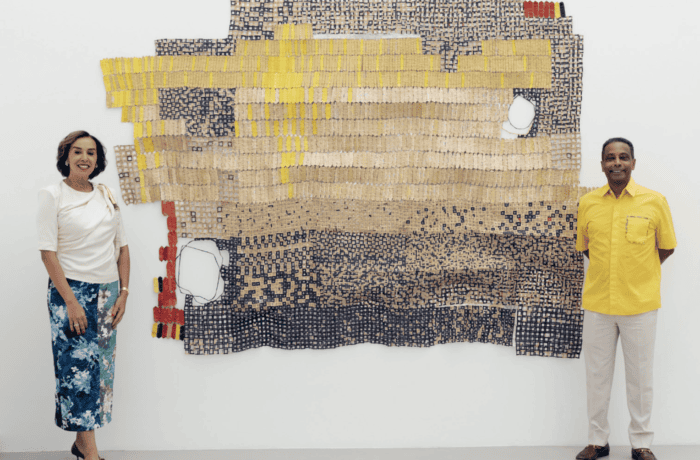
Yantrasast with artist Kelly Akashi and art-world banker Agnes Lew
I say this because culture has the power to bring people together. We don’t care who they are, but we love that food, we love that music. I think that museums are – like the project we’re doing at the Louvre, where Byzantine, Roman and early Christian areas work together with the Islamic wing – trying to create that sense of empathy, so people can see that, if we look closely, we all come from similar roots.
Read more: Mercedes-Maybach S-Class Review
MS: This is beautiful what you just said, this democratisation of the museum space. Because museums could be quite intimidating for people, but we see more and more that people go to museums and they’re curious about what happens inside. But back to what you speak about, I spoke about empathy because your practice speaks about empathy. How do you think empathy translates into your architecture?
KY: First of all, people need to feel dignified. They need to feel that they’re welcome and can feel their own presence. Good spaces make you feel that, good spaces make you feel your life and your potential. Once you are comfortable, once you feel you have a place, then you are able to really look at other people in a loving and understanding way. That sense of care is important in architecture.

Kulapat Yantrasast with interior designer Kelly Wearstler, photographed in Jaipur
My pet peeve is that I really hate it when spaces are not designed well, when they make people hate each other. Even something as basic as a queuing system can make people feel peaceful and wait for their time, or make them rush and push each other. That’s something we can design. I sometimes joke in my office: you design a house for a couple, and they can love each other or hate each other, it’s in your hands. If you design something a little too small, or not the right proportion, or not the right layout of the bathroom or kitchen, people end up in conflict.
Within that, there is humanity and humility in design, in planning and in aesthetic architecture, which can really bring people to understand each other further, not only people from different backgrounds, but even people who live together, like a family.
I’m very interested in the seamless indoor-outdoor component, maybe because I’m from the global south, where the climate allows you, or wants you, to be indoor-outdoor. I’m not in a strict cold climate, where there’s a severity between the outside and the inside. So I have that view and experience of nature that way.

Kulapat Yantrasast’s personal sketch of DIB Bangkok, devoted to LUX
I want to go back to what you said, because the idea of ego, the idea of form, is so important in architecture. People love sexy forms. It’s like fashion, like other things. But what I always say in the office is: design the life, not the form. Don’t stop at form. Form is only your tool to design the life you want people to live.
MS: What about the role of landscape?
Read more: Four Seasons Hotel Istanbul at Sultanahmet Review
KY: We have a multidiscipline studio. One of them is landscape, and we include our landscape team in projects when we’re not working on landscape, because I like the way they think. It’s a very different approach, because landscape designers think holistically. They think about the context of the city, continuity from the city to the site, and they think about time.
A garden, when it is first created, may be the least beautiful, because it grows over time. Whereas architecture, the first day it opens may be the most beautiful, and then it degrades. Because of that, I want my architects to think about how a place works over time, when trees grow bigger, when materials degrade. I think the philosophy from landscape can inform a lot of architecture.