


“Autocrats, extremists and fascists hate art. Art is a threat to them because it humanises the people they demonise”, Arch Hades photographed by Jon Gorrigan, 2026
Having rocked Venice with a solo exhibition during the Biennale, artist and poet Arch Hades unveiled Happening, a play about how artists can resist fascism, during Frieze London. More shows follow around the world. Thoughtful, intellectual and with a powerful moral compass, she speaks with curator and impresario Clayton Calvert about writers, geopolitics and propaganda
Follow LUX on Instagram: @luxthemagazine
Clayton Calvert: How and when did you begin to pursue life as an artist? Did you start by writing or have you always worked in various media?
Arch Hades: It didn’t begin with artistic intention, but I have been keeping diaries for nearly two decades now. At an early age I realised my memory is garbage (my therapist keeps calling it “dissociative amnesia”) and, while I cannot recall years of my life, at least I wrote it all down as it was happening, so I can revisit those journals whenever I want. I kept the habit, it’s one I enjoy, and now a great volume of my work is the product of fastidious journalling, so I’m glad I put in the time. When you read widely and write frequently, you organically find yourself drawn towards a particular style or type of expression, and the moment I began to feed on confessional, Romantic, lyrical poetry, I knew I somehow must become a poet. I must become willing to risk embarrassment in pursuit of human connection.
Read more: Maryam Eisler interviews Kenny Schachter
CC: What is your artistic process like? How do you determine which ideas to explore as well as which concepts work well together?
AH: Everything starts with language. If I feel like I have nothing, that I am nothing, I still have words. I can ride language as if on horseback, and it can take me anywhere, including more deeply into myself. To write one book, I have to read at least 20. The more I read, the more I can write. To paint one picture, I have to look at a hundred different visuals and see what my mind retains, what I keep coming back to and why. All the art objects I make, the sculptures and the soundscapes, originate from my poetry. The paintings originate from a mixture of existentialism and whatever else I’m experimenting with at the time, or whatever I’m influenced or moved by. I wish I had a formula regarding which concepts work well together visually! But this process is largely intuitive. To start, I must explain to myself what idea I want to express in a painting and then figure out how to best translate that visually. It’s an ongoing wrangling. Goodness knows it doesn’t always work.
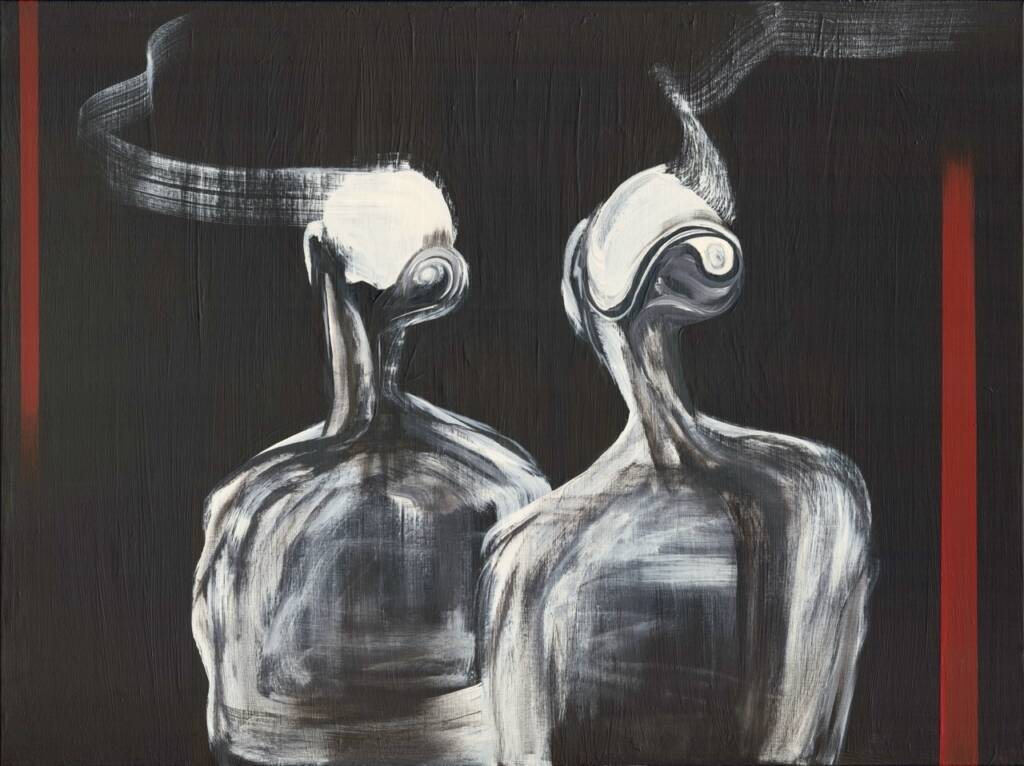
Pair, 2024 by Arch Hades
CC: Who are some of your greatest inspirations as artists and writers?
AH: In terms of writers: Somerset Maugham, Kurt Vonnegut, Joseph Brodsky, Mary Oliver. In terms of artists: it fluctuates (currently, I’m knee-deep in Byzantine iconography), but the staples are Francis Bacon, René Magritte, Franz Sedlacek. In terms of performance: Alan Shore played by James Spader. Before performing live, I binge-watch his best closing arguments backstage as a ritual.
CC: How does your work as a poet overlap with your painting, sculpture and performance practices?
AH: First, whatever the work is, it has to be honest – that comes from poetry. Half the poet’s job is to embrace radical honesty. The other half is to do it well, in an original, interesting way. If I find a thought, feeling or idea is best expressed in an object, sculpture or installation, I do my best to figure out how to best imbue it with my written word. None of my work is subtle. But nothing has ever achieved greatness by being subtle.
Read more: Pirelli HangarBicocca in Milan shows Aki Sasomoto and Luciano Fabro
CC: What do you hope to achieve with your latest project, Happening?
AH: With the rising tide of right-wing extremism, info wars and fear mongering propaganda in a viral, digital era, I hope Happening will convey at least one way individuals can resist autocracy. There are, in fact, many ways we can resist what seeks to crush us. And we must remind others that even if they lick boots, they are more likely to be crushed by those boots than be the ones wearing them.
We must remember that autocrats, extremists and fascists hate art. Art is a threat to them because it humanises the people they demonise in order to seize power and control. Art is a threat to them because it reminds the individual of their autonomy, by deepening empathy and widening our perspectives. Art reminds people that power resides where we believe it resides. And that the nature of evil is nothing more than a lack of empathy.
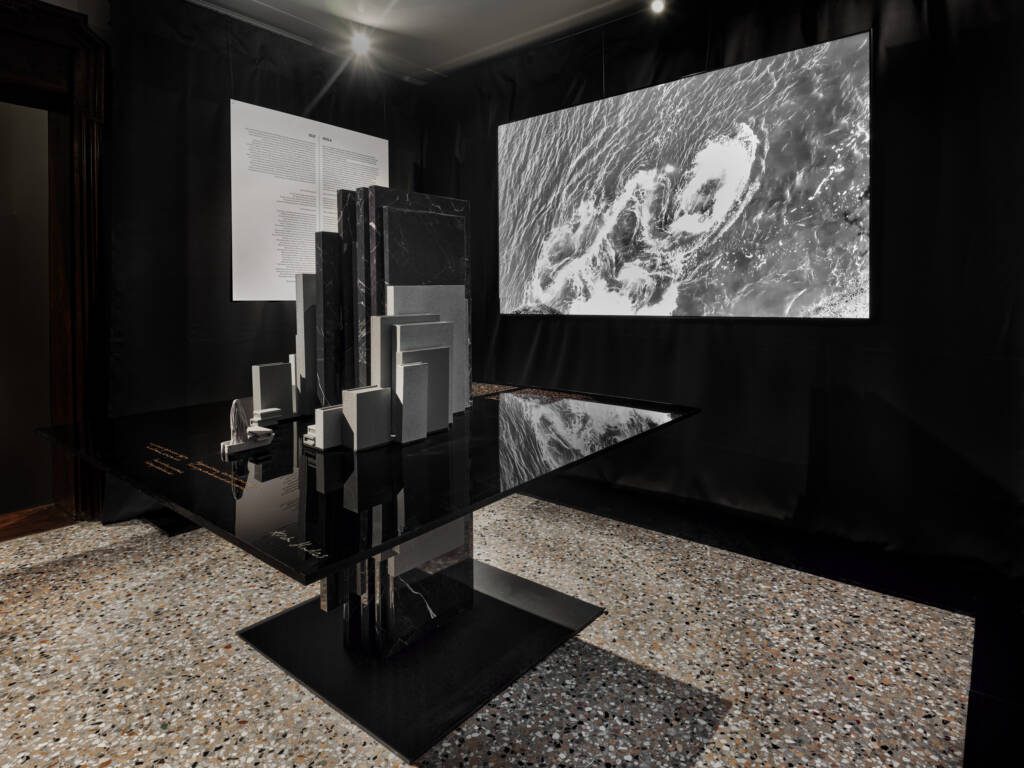
Isle, 2024 by Arch Hades at her solo exhibition Return/Ritorno, Venice, 2026
CC: Do you believe that propaganda is something people need, want and yearn for?
AH: I agree with Jacques Ellul that propaganda is something people have room for. The real power of propaganda is not to convince, but to give you a sense of belonging. It isn’t just foisted from above, it’s a by-product of a breakdown of community, a remedy for loneliness in a society where we have diminishing control over our lives. Propaganda can give you both a community and the illusion of individual agency. It satisfies a need to belong. One of my ongoing purposes in life is to draw attention to the fact that art can provide us with belonging and community. Art, after all, is a product of community itself.
CC: Are you disillusioned with democracy and the current global geopolitical climate?
AH: I’m certainly disillusioned with the current state of politics in late-stage capitalism, which is why I stepped away from politics in the first place. After years in Westminster, I had a Farnsworth “I don’t want to live on this planet any more” moment. But my devotion to democracy has not wavered. Democracy is a dawdling beast, and the wheels of justice and progress spin slowly, but they still spin. Happening is my ode to democracy, my serenade. It’s the main reason for all the freedoms in my life, and all the richness that comes with said freedom.
CC: Your work Return/Ritorno also included provocative text excerpts as well as engaging prompts like: “Am I what I regret? Am I my doubts? Am I my secrets?” Do you have any answers to those questions?
AH: I feel pretty lucky that I live with three regrets, no secrets and most of the doubt is fleeting. But the answer to the riddle of my Sphinx sculpture, which is imbued with many questions directed at what the self can be, is: “You are the sum of your choices”. You are not responsible for what life throws at you, but you are responsible for what you do with it. At any time, you can make different choices and create a different self. Sphinx is my ode to existentialism.

The Witness, 2022 by Arch Hades
CC: What role can art play in the betterment of society? Can it also have an adverse effect?
AH:For me, art will always be an essential in life. If you don’t connect with bigger things (like art, or nature, or love), you will make the mistake of believing you are the big thing.
Read more: Miles Aldridge’s 15 Minutes of Fame Polaroid Project
CC: Do you have moments of self-doubt as you work, and does the process of making art help resolve these?
AH: I shall answer this question by giving you two excerpts from my diary this month: Thursday 6th August, I’ve been painting all day. I feel marvellous. Everything is light again. Monday 10th August, Doubt. Misery. Everything I’m painting is unimaginative to the point of garbage. I am garbage. I am trash. Derivative. Contrived. I need a coffee. But, hey, sometimes you just need a coffee, a break, and then pick things up the next day.
CC: What would be your dream exhibition or project?
AH: Great question. I have a specific exhibition I would love to put on soon (installation! soundscapes! poetry! art objects!), because I’m finally ready to let go of something I’ve been keeping to myself for too long. For too long these memories have felt like a gun I would load myself, and I’d pray for it to jam, and it never would. It’s time to put it all down.

Sphynx, in Venice, 2026
CC: Do you believe your art to be an extension of yourself or a mirror for society?
AH: I hope both. I’m certainly influenced by my environment and I am a tiny part of society. But I hope what I put out there, as an extension of myself, can, in turn, influence other tiny parts of society.
CC: What do you hope is your work’s long-term impact?
AH: I’ll be content if what survives of me is love.
‘Happening’ is on show at No. 9 Cork Street from November 26th – December 19th



Recent Comments