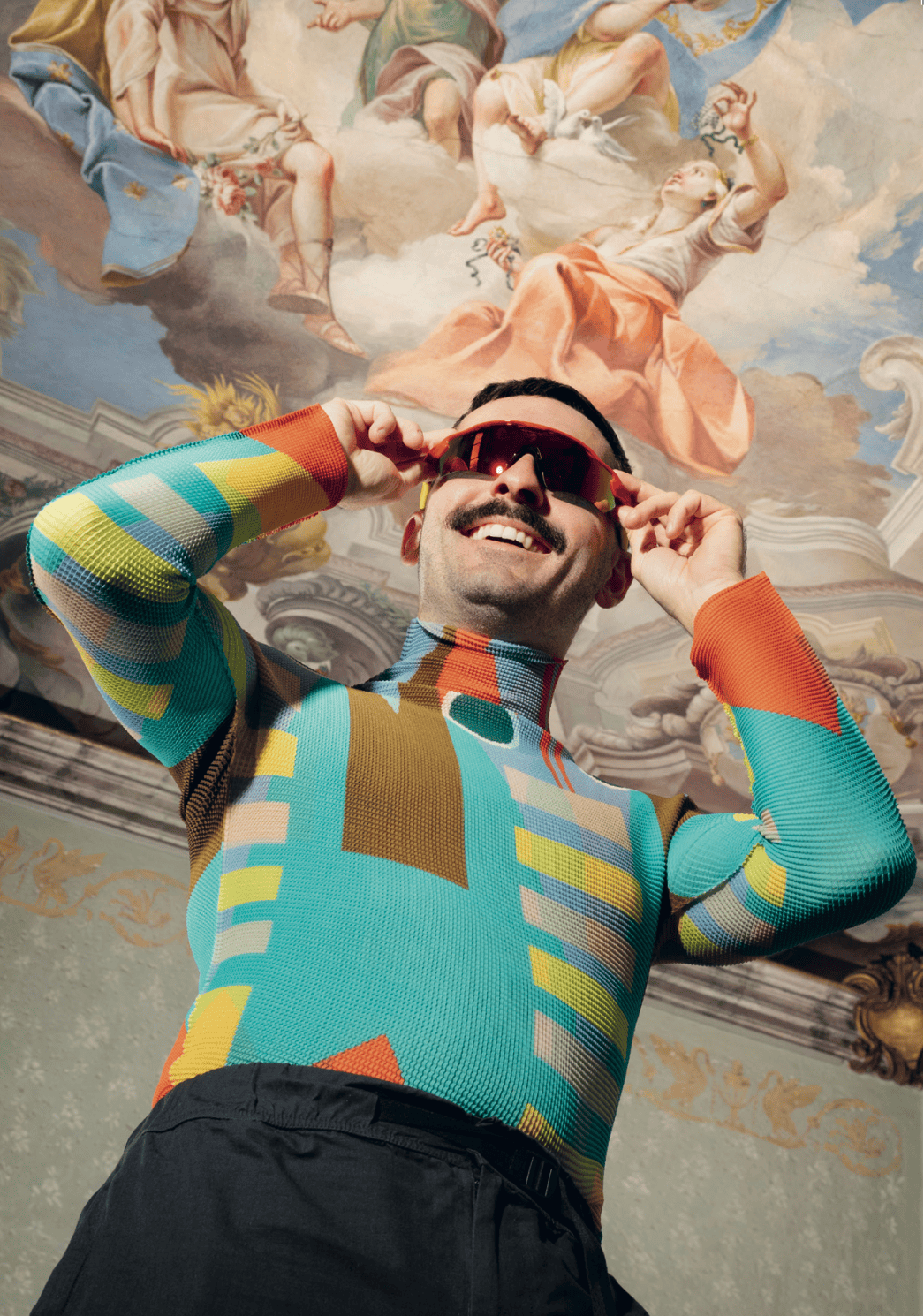
Edoardo Monti photographed with a 1750 fresco at Palazzo Monti

Since Edoardo Monti started his Palazzo Monti artists’ residency in Brescia, northern Italy, in 2017, it has evolved to become one of the most tasteful, sophisticated and respected artist residencies in the world, supported by patrons such as local hero Umberta Gnutti Beretta. Many of the more than 250 young artists he has featured have since exploded on to the global art scene, and collectors keep a careful watch. As the Palazzo opens its third space this year, in a Brescia bunker, Monti tells LUX the story so far, and two key collectors comment on what makes it important

“I started the Palazzo Monti Residency quite instinctively – I wanted to live surrounded by artists, to create a space where they could feel free, supported and genuinely at home while working.

An artists’ living room at the Palazzo Monti with Slick Submissions, 2018, by Bea Bonafini

In terms of discovering the artists for the residency, it’s mutual – we find each other. I am drawn to artists with a certain sensitivity and urgency, something you feel immediately, before you can even explain it.

Follow LUX on Instagram: @luxthemagazine

Often, the relationship starts quite intuitively, but it develops over time into something much more layered. Many of the artists who pass through Palazzo Monti don’t just come for a residency – they stay connected, come back or evolve with us in different ways.
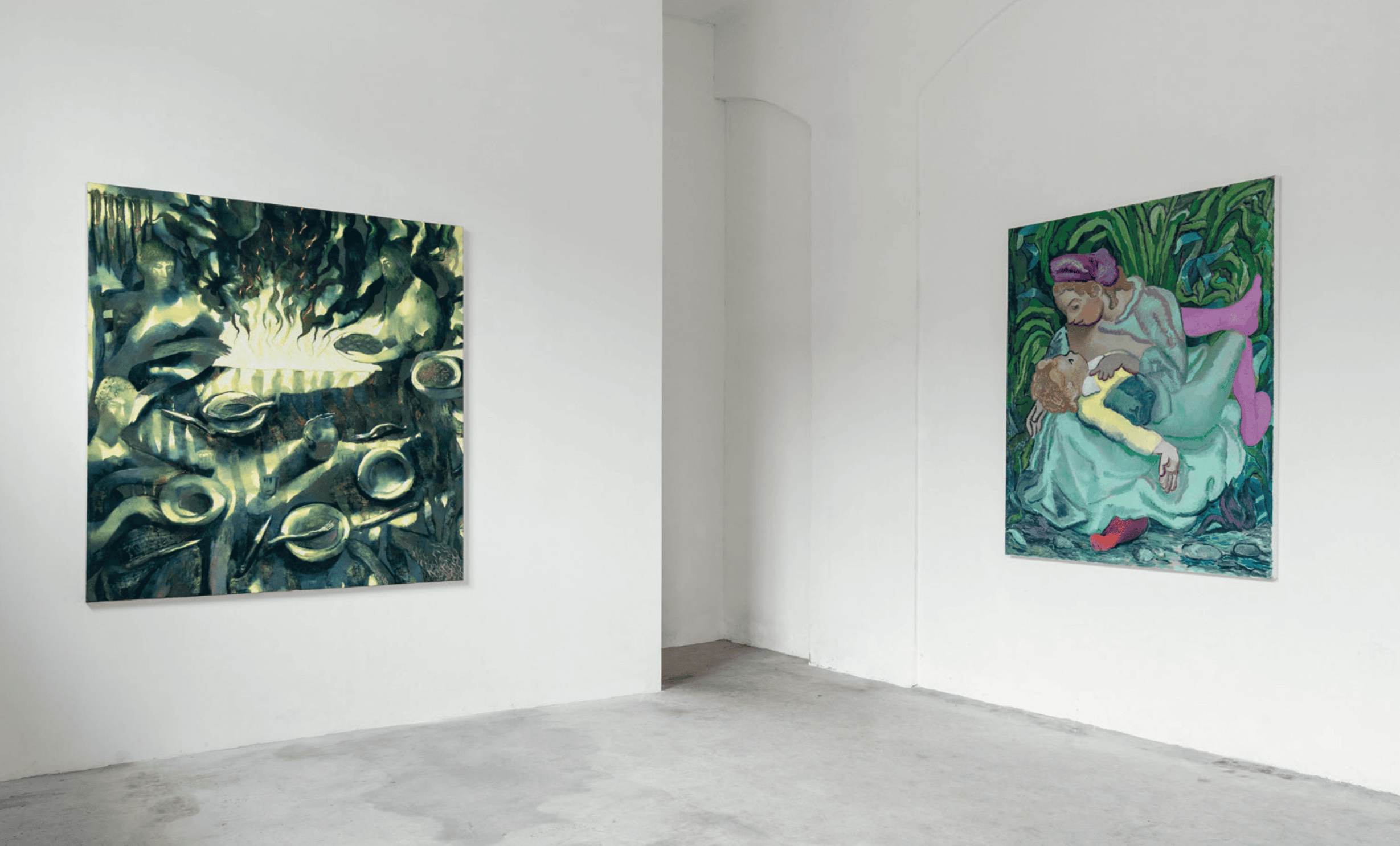
The palazzo’s nearby second space, Fertile, with La cena del cacciatore, 2024, by Luca Ceccherini, and Then Glut Thy Sorrow on a Morning Rose, 2022, by Delphine Hennelly

There’s a sense of continuity that becomes very important. For example, there have been artists who arrived at an early stage of their practice, using the residency as a moment of experimentation, and then returned later with a much more defined body of work, sometimes even exhibiting in the same spaces where they started. In other cases, collaborations have extended beyond Brescia, through exhibitions, introductions to collectors or simply ongoing dialogue.

In 50 years time, I would like history to say that Palazzo Monti was a place where artists felt seen early on, where important practices were nurtured quietly and where meaningful relationships began and lasted over time.”

– Edoardo Monti

The programme’s Fertile space with Nobody But You/Nobody’s Gonna Fuck Me Like Me, 2019, by Sophie Spedding

“Palazzo Monti stands out for its ability to nurture artists at a pivotal stage in their careers, thanks to Edoardo’s thoughtful and hands-on approach. The residency brings forward compelling practices. I am glad to have works by Konstantina Krikzoni, Georg Wilson, Natalia Gonzalez Martin, Anna Ruth, Charlotte Edey, Diane Dal-Pra, Lindsey Bull and Nour El Saleh in my collection, discovered through the programme”

Read more: Artists through the eye of Patrizia Sandretto Re Rebaudengo

– Francesca Milani, collector and patron

The new gallery space Bundervik, set in a former air-raid shelter

“I see Edoardo Monti’s residency at Palazzo Monti as a vital platform for emerging artists, fostering meaningful dialogue and experimentation. His vision creates a rare balance between support and freedom. I have followed several artists from the programme closely and I am pleased to have work by Sara Birns, Oxana Tregubova, Konstantina Krikzoni and others in my collection”

– Warly Tomei, Venice-based collector and patron

palazzomonti.org

Share:
Reading time: 2 min
palazzo
palazzo

Dating back to 1775, this building is nearby the Basilica of Santa Croce in Lecce

Authentic. immaculate, aristocratic, contemporary family-curated luxury in a Baroque palace in a city that’s a living museum? Take us to the Palazzo Bozzi Corso in Lecce, Puglia

Authenticity is becoming an ever greater part of the luxury travel experience. People want experiences when they travel, and cookie-cutter luxury simply doesn’t cut it anymore.

That’s why you get French and Italian fashion and luxury creating spectacular hotels in territories as far apart as Australia and Las Vegas. But authenticity cannot be created through replication or over the Internet; by definition it is something that comes from inside.

outside

The hotel was designed by the 18th-century architect Emanuele Manieri, this historic building attained its unique blend of traditional and contemporary features when it was developed in conjunction with the La Fiermontina Family Collection.

That, more than anything else, is what strikes you when you walk into the Palzzo Bozzi Corso. You are walking along a historic street in Lecce, in the heart of Puglia, buzzing with tourists, locals, craft shops, wine bars, local food markets.

room

Dedicated to the memory of the boxer and actor Enzo Fiermonte, La Fiermontina Palazzo Bozzi Corso offers its guests spaces with ornate furnishings and artworks

This is and was a wealthy town and the Baroque era buildings are grand and imposing. Then you walk into the Palazzo and you are whisked into the private home of a wealthy merchant of hundreds of years ago: the equivalent of walking into a Rockefeller house in a different era.

Except the Palazzo Bozzi Corso has been sylishly and impeccably updated so it feels almost like a perfectly curated exhibition, a museum of contemporary and 18th century Italian design, immaculately reimagined as an intimate luxury hotel.

Art by the likes of John Lennon (a friend of the owning family) and Fernand Leger sits among the Renaissance artefacts; no interior designer in the world could create a passion project so warm and thoughtful. This is a place to live, or at least to stay for as long as possible.

room

The building is also home to original drawings by John Lennon, donated by Yoko Ono, a friend of the owner’s mother.

There are only 10 suites here and every one is different: ours had a stone arch above the bed, church-like high ceilings, modernist furniture, a combination of ancient and contemporary art, eggshell walls, vast mirrors. Bathrooms are out of a show suite at Milan Design Week, except the work, both physically and in the destination.

Walk out of the building and you are in the living museum of Baroque that is Lecce; there is a roof terrace, and you can use the pool in the garden at the nearby sister hotel (also gorgeous), La Fiermontina. Authentic luxury doesn’t even begin to describe Palazzo Bozzi Corso.

Guests also have access to the secret garden and rooftop terrace to see the sunset

www.lafiermontinacollection.com/en/palazzo-bozzi-corso

Darius Sanai is Editor in Chief of LUX and an Editor in Chief at Condé Nast International

Share:
Reading time: 2 min
A man wearing a green, yellow and purple colourful top putting on red sunglasses

Edoardo Monti

In the seventh part of our Italy art focus series, curated by Umberta Beretta, LUX speaks to Edoardo Monti, who at 26 established an artist residency at his family’s 13th-century Brescia palazzo. Since 2017, it has already hosted more than 200 artists from 50 countries

LUX: Palazzo Monti is very significant architecturally. Does it influence your artists?
Edoardo Monti: The palazzo has a powerful effect. It is calming, it has stunning light and there is lots of space, so you can focus on your art in private during the day, but there is always someone in the communal spaces to chat with. The city, too, leaves an imprint. Bergamo and Brescia are Italian Capital of Culture 2023, and there are many cultural activities and museums that help with research and production. Lastly, there are the artists: they create a beautiful bond that carries on after they leave Italy.

A table and chairs in a room with art leaning on the walls

Pescatarians in the Hands of an Angry God, 2017, by Chloe Wise; Edo a Tavola, 2019, by Maria Fragola, and Late Breakfast, 2019, by Kyle Vu-Dunn, at Palazzo Monti

LUX: How do you choose the artists?
EM: We receive more than 700 monthly requests. We don’t care whether artists studied or are self taught, where they live or their age. We just look for art we have never seen before.

Follow LUX on Instagram: luxthemagazine

LUX: What is your favourite Palazzo artwork?
EM: I can’t get enough of Interior III by Christina Kimeze. It shows the artist and my dog, Beatrice.

A painting of a green monster on top of a wooden table

View of Nobody Like You/ Nobody’s Going to F*ck Me Like Me, 2019, by Sophie Spedding at Palazzo Monti

LUX: You worked for 10 years at Stella McCartney. Why did you change direction?
EM: I left Italy at 18, so it felt natural to move back when I was 26 and live as an adult in the country I love. Then there was the palazzo, where I had never lived, but which I thought had so much potential, and wanted to help express. Lastly, I had started collecting art at 14 – mainly figurative art, which is still a main focus – and I wanted to dedicate myself to my passion, working with artists from around the world.

LUX: What were the challenges?
EM: I missed NYC for a while, but Italy is pretty awesome, too. The challenge was to become known in the art world, which we did through social media and our alumni, as each becomes an ambassador back in their own city.

A white marble staircase in a hallway with painted walls and large wooden doors

A view of the Palazzo Monti with hints of its art residencies

LUX: Do you choose the artists to fit together?
EM: We don’t strategise. We host three artists at a time, and have been lucky to have groups that bonded. We have a large communal kitchen and dining area, where we often enjoy dinners together. We can’t guarantee positive experiences, nor wish to impose a social life. We respect that some artists come to enjoy living in a centuries-old palazzo and to work in our large studios.

Read more: Italy Art Focus: Arturo Galansino

LUX: What are your aspirations now for Palazzo Monti?
EM: We want to work more with curators so our artists have even more support. We are also opening our exhibition spaces to other projects, as we become more of a cultural centre with a residency, exhibitions and a private museum.

Find out more: palazzomonti.org

This article comes from a section of a wider feature originally published in the Autumn/Winter 2023/24 issue of LUX

Share:
Reading time: 3 min