


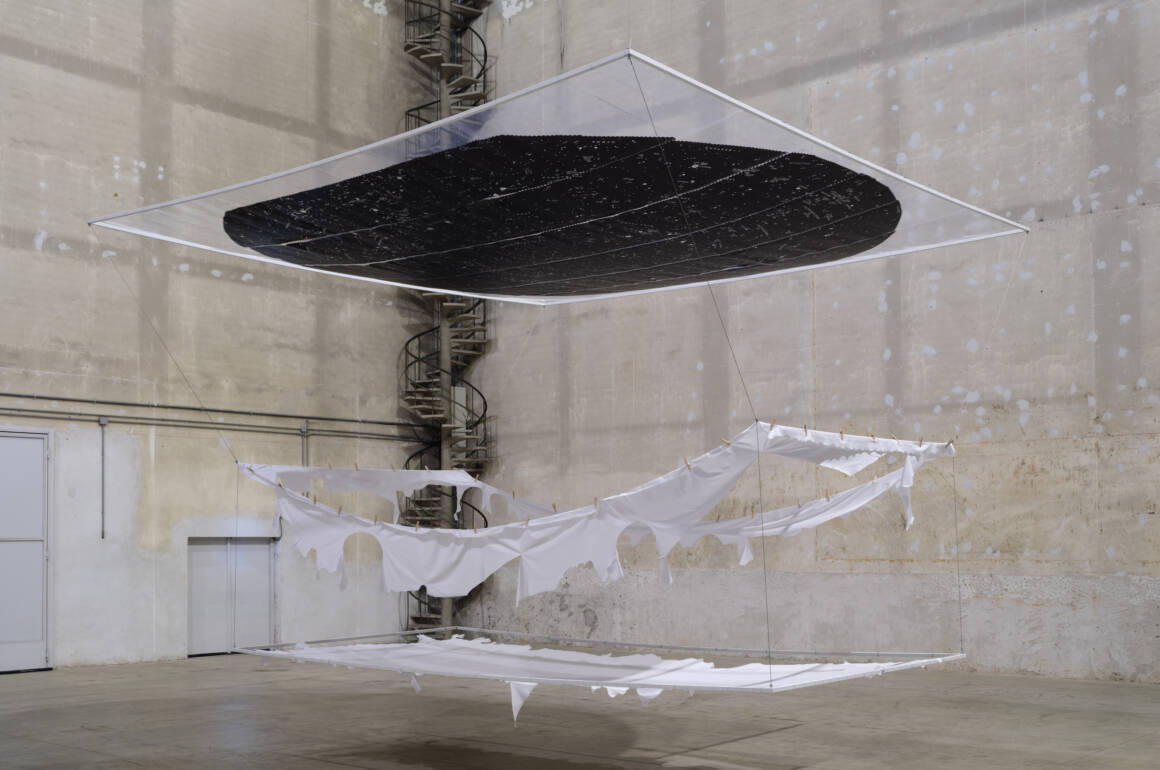
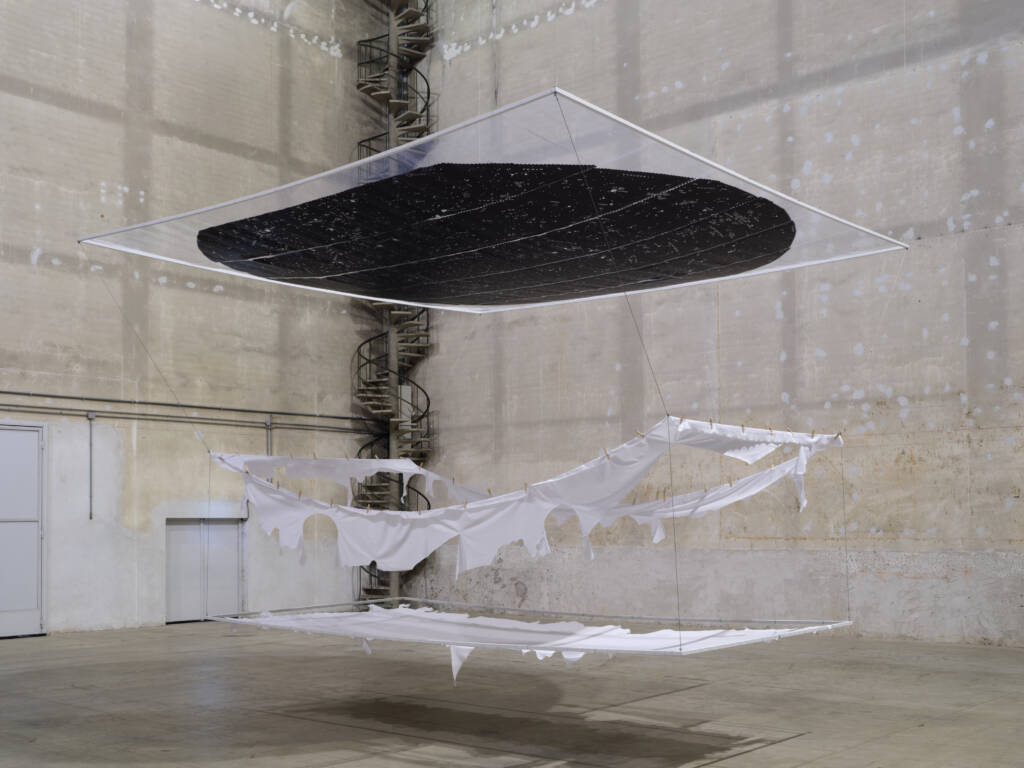
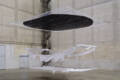
Luciano Fabro, È la vita è la storia è la morale 1995. Installation view, Pirelli HangarBicocca, Milan, 2026.
In Milan’s Bicocca district, in a hall where locomotives were once assembled, Aki Sasamoto is turning maths into something you can walk through. Next door, Luciano Fabro’s first major show in over a decade, takes over. Pirelli HangarBicocca has timed its autumn so that both shows are on view together. By Annie Preston
Follow LUX on Instagram: @luxthemagazine
Aki Sasamoto was born in Kanagawa in Japan in 1980 and lives in New York. Before she learned that performance, dance and sculpture could be studied at all, she assumed she would become a mathematician. “XYZ”, curated by Roberta Tenconi with Tatiana Palenzona and organised by Pirelli HangarBicocca in collaboration Kunsthalle Wien, is her first solo show at a European institution and spans more than twenty years of work.
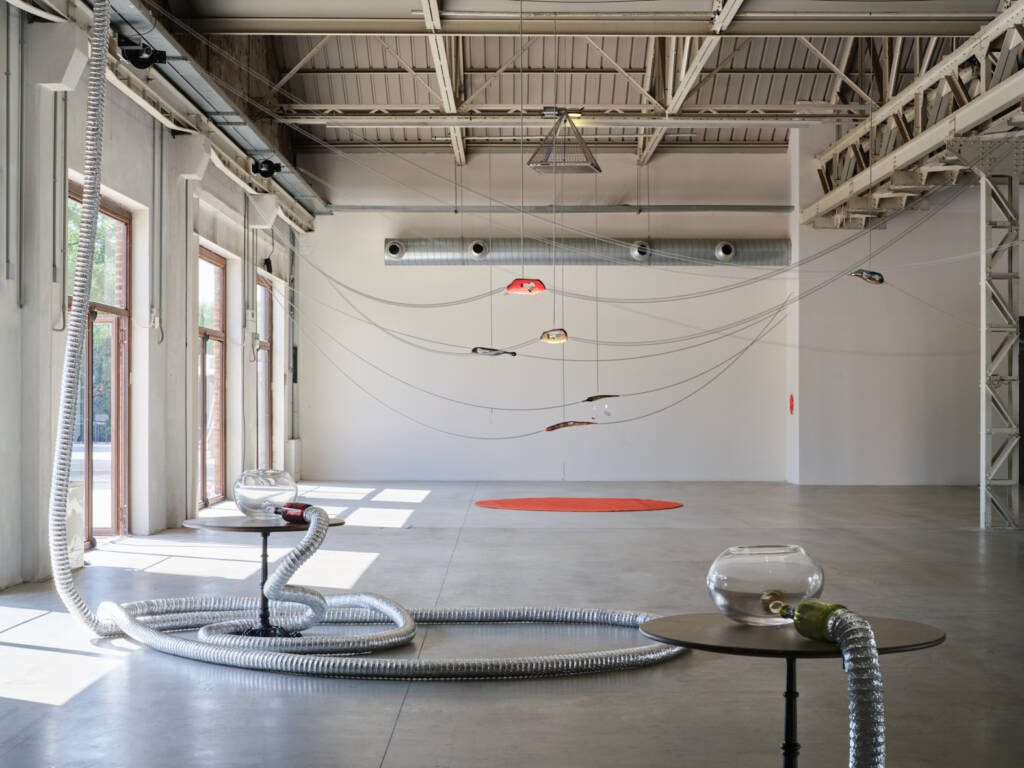
Aki Sasamoto, XYZ , 2026. Exhibition view, Pirelli HangarBicocca, Milan.
Installation, sculpture, video and live performance sit side by side, each treating everyday objects and human awkwardness as experiments with variables that refuse to behave. Strange Attractors (2010) and Wrong Happy Hour, first made in 2014 and restaged for 2026, share the “Shed” with Centrifugal March and Delicate Cycle. In Past in a future tense (2019), whisky tumblers drift inside spheres of Murano blown glass, moved only by air. Sasamoto has said her work is about the problems of life rather than the problems of art, the work acting as a “lab” in which she can test those problems on visitors.
Artistic Director Vicente Todolí told LUX, “With the exhibitions in Pirelli HangarBicocca, we aim to map out an evolving journey […] each exhibition resonates with others, creating a shared experience that fosters an authentic relationship between the artwork and the audience.” He describes the museum as “a living organism capable of raising questions about the present and offering visitors new perspectives.”
Read more: Rachel Verghis in conversation with Rolf Sachs
The site that now houses Pirelli HangarBicocca began in 1903 when the Breda group, which built railway carriages and steam and electric locomotives, moved to the Bicocca district. Three of its factory buildings are now exhibition halls: the “Shed”, the vast “Navate”, and the “Cubo”. Pirelli’s real estate arm bought the complex in the mid 1990s, and since 2004 has run as a non-profit foundation, opening with an installation by Anselm Kiefer, which is permanently housed in the “Navate” building. Admission is free, with two shows a year by established artists exhibited in the “Navate”, and two shows by younger, mid-career names staged in the “Shed” building. It is now a fixture on the itinerary of anyone following contemporary art in Milan and beyond.

The museum opened in 2004 with Anselm Kiefer’s The Seven Heavenly Palaces, a site specific installation permanently on show in the “Navate”.
Past solo shows read like a survey of contemporary art: Bruce Nauman, Marina Abramović, Steve McQueen, Nan Goldin, Carsten Höller, Maurizio Cattelan
, Philippe Parreno, Mike Kelley, and Lucio Fontana, just to name a few.
Where Sasamoto works in motion, Luciano Fabro works in stillness. Born in Turin in 1936, he moved to Milan in 1959 and became a central figure of Arte Povera and postwar Italian art. From the 1960s, he treated sculpture as a way of asking how a person occupies a place, using marble and iron alongside glass and silk, chosen for what they make you feel as much as for how they look. He taught at Brera from 1983 to 2002, with generations of Italian artists passing through his classroom before he died in 2007.
Read more: The South of France is the new hot art destination
“Inhabiting Space” is the first Italian museum retrospective of his work since then, and his first major international show since showing in Madrid’s Reina Sofía in 2014. Nearly fifty works are on view, tracing a path from early pieces such as In Cubo (1966) through to later sculptural works such as Eclissi di cielo (2006). Some of the large environments, which Fabro called habitats, have been rebuilt from his original plans and instructions. The centrepiece is a reconstruction of Habitat di Rotterdam (1981), the temporary environment he devised at the Museum Boijmans Van Beuningen to hold more than twenty works. Here it becomes a show within the show.
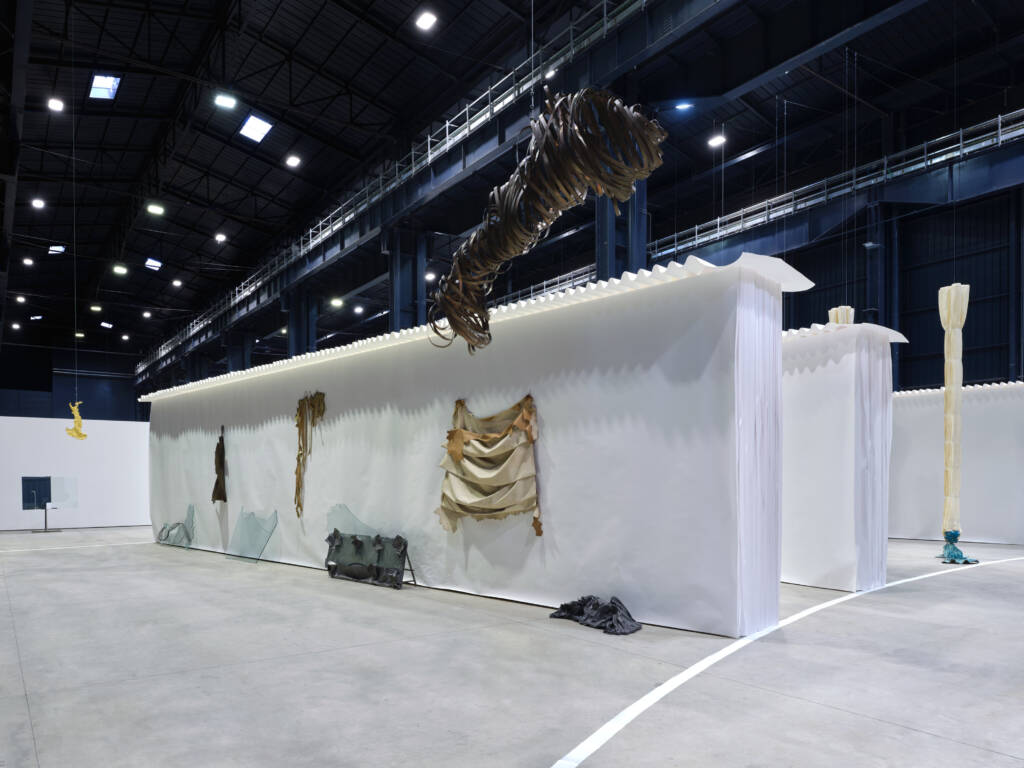
Fabro’s Habitat di Rotterdam, devised first for the Museum Boijmans Van Beuningen in 1981, is a central part of the show, a temporary environment that becomes an exhibition space in its own right.
The curators Fiammetta Griccioli, Roberta Tenconi and Vicente Todolí, who collaborated with the Archivio Luciano e Carla Fabro, put it this way: “For Lucian Fabro, sculpture was never simply an object but a way of thinking and reshaping perception.” They add that in his work, “works, architecture, and human presence form an active field of relationships, a place where to ‘feel well.’”
It would be easy to say the two artists have nothing in common. One is a performer with a mathematician’s mind, the other a sculptor with a philosopher’s patience. But walk from one hall to the other, and the question stays the same: what happens when a body, an object and a room are put in the same place? Sasamoto gives an answer that is playful and unstable; Fabro, one that is calm and exacting. Milan gets both for the price of a metro ticket and nothing else.
Aki Sasamoto: “XYZ” (Shed, until 17th January 2027),
Luciano Fabro: “Abitare lo spazio. Inhabiting Space” (Navate, until 21st February 2027)



Recent Comments